
National Centre for Physics · Shahdrah Valley Road, Islamabad
+92 51 2077300 Ext. 494 · nstdncp@gmail.com
Electrochemical & Electrical Analysis

Electrochemical Impedance Spectroscopy (EIS)

Characterizes electrical properties of electrochemical systems by applying a small alternating-current signal over a wide frequency range. The impedance response is used to examine internal resistances, capacitance, and charge-transfer kinetics.
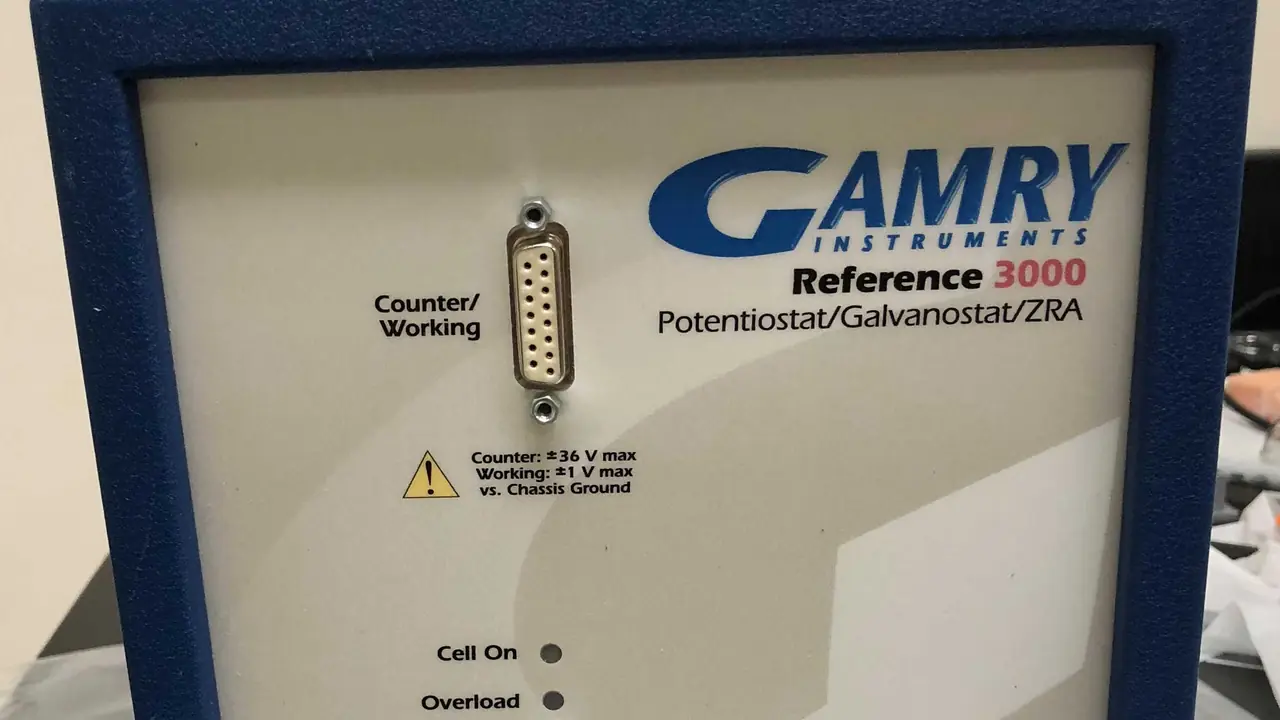
Potentiostat used for impedance measurements

What the measurement provides

  • Internal resistance
  • Capacitance
  • Charge-transfer kinetics
  • Evaluation of batteries, fuel cells, and corrosion processes

Sample requirements

  • State the nature of the sample (for example hazardous, volatile, or explosive).
  • Minimum of 50 mg of sample for the three-electrode method.
  • Coated samples: 1 × 1 cm² of coated substrate with 0.5 cm² uncoated area.
  • Only properly prepared solid samples are acceptable.
  • Mark EIS under type of measurement. Electrolyte may be acid, base, or neutral.
  • Provide potential window, constant current, electrolyte molarity, and electrode details as requested.

The same electrochemical proforma also covers CV and CCD. CCD appears on the form; a separate CCD rate is not published.